Three kinds of map, defined plainly
Mind maps radiate from one central word, with branches for associated ideas. Tony Buzan popularised the format in the 1970s, notably in the book Use Your Head (1974). They are good for brainstorming and recall, less good for showing precise relationships, because branches rarely say how ideas relate.
Concept maps were developed by Joseph Novak and colleagues at Cornell University in the 1970s. Their defining feature is the linking phrase: every line between two concepts carries words, so "photosynthesis — produces — oxygen" reads as a statement. That makes them closer to labelled knowledge links.
Question maps are our name for a practical hybrid: a central research question, with sub-questions around it and the notes or sources that answer each one. They are designed specifically for resuming unfinished work.
An annotated question map
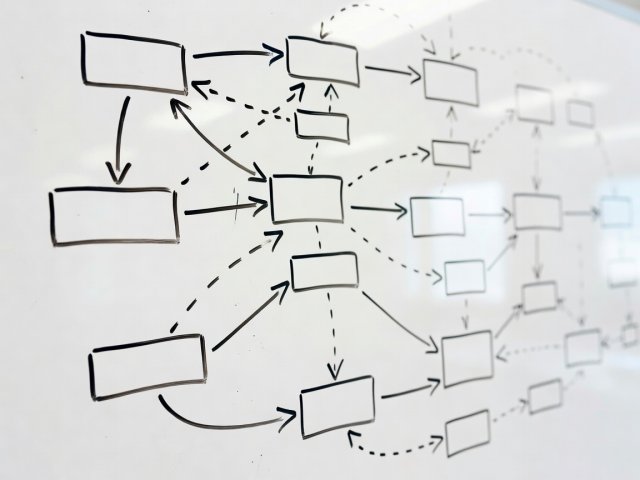
The fictional map below belongs to an imaginary project about why a community library's evening visits fell. Each box is a note or question; each line has a label.
From map to searchable outline
Image files and canvas boards are hard to search. Some apps index text inside them, many do not, and exports often lose it. So after a mapping session, spend five minutes writing the map as a plain outline in a note. The map above becomes:
[photo of whiteboard]
library_map_final_v2.png
# Q: Why did evening visits fall? (fictional)
- Opening hours? → answered: [[2025 schedule change]]
- Transport? → OPEN, no notes yet
- Programming? → partly: [[Visitor survey summary]]
Map image: library-question-map-2026-02-02.png
The outline keeps the structure, the labels and, crucially, the status of each branch. When you return in a month, "OPEN" tells you exactly where to resume.
Keep maps small and dated
Large maps feel productive to make and are discouraging to revisit. If a map passes about a dozen nodes, split off a sub-question into its own map and link the two outlines. Put the date in the file name using ISO 8601 order (YYYY-MM-DD) so versions sort themselves.
Paper maps count too
A pencil sketch on squared paper is often faster than any app. Photograph it, give the photo a descriptive file name, and write the outline next to it. The photo preserves the shape; the outline preserves findability.
Realistic limits
Maps simplify. They are good at showing what parts a question has and poor at holding nuance or evidence. Treat them as a table of contents for your thinking, with the substance living in the linked notes.